By Charles Baran
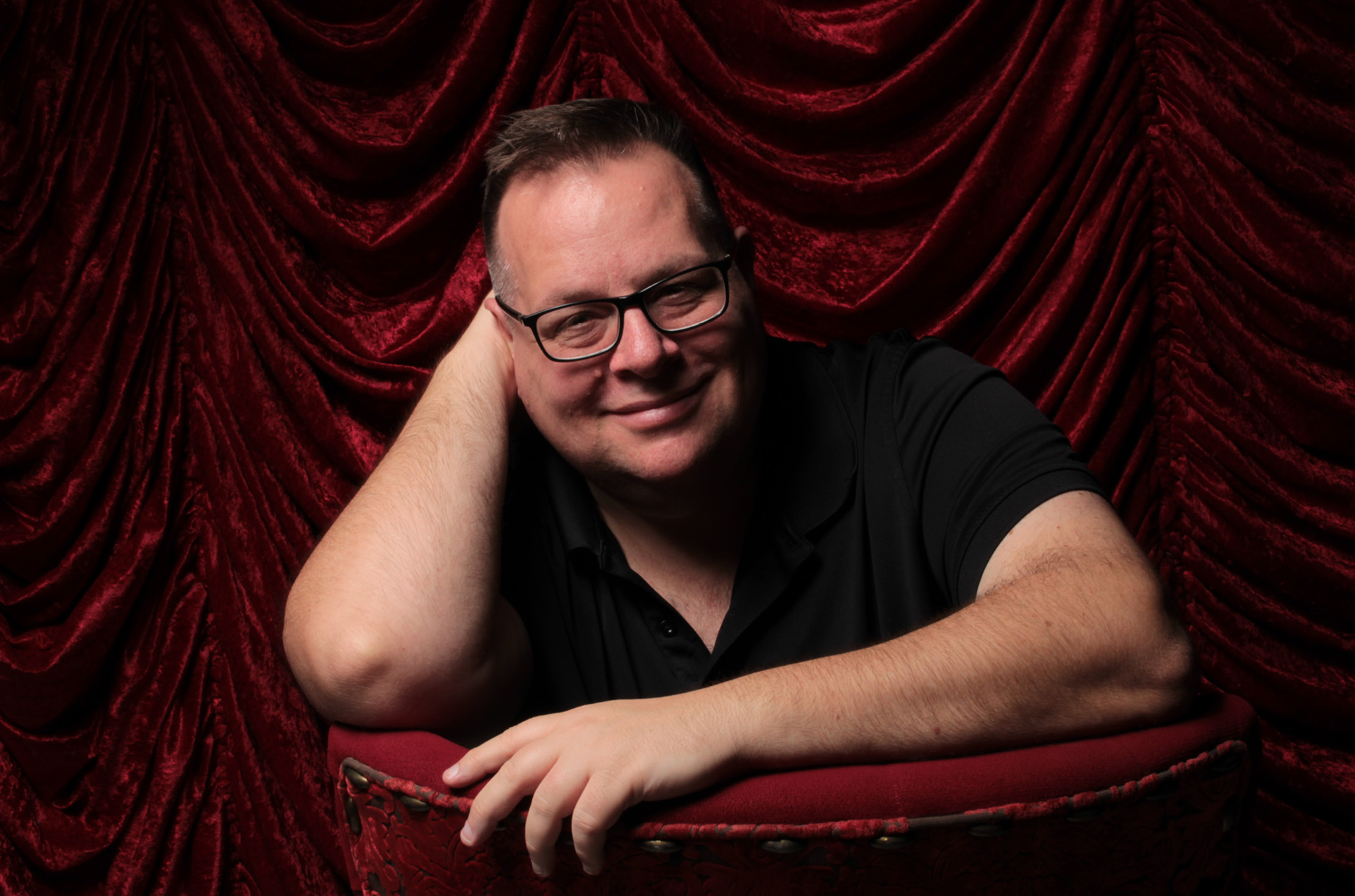
When describing South Florida theater impresario Ronnie Larsen, the word “zen” doesn’t usually come to mind. Yet, backstage at The Foundry, amid the hustle and bustle of the actors and stagehands arriving for the evening performance of Ronnie’s big hit play—aren’t they all a big hit?—10 Naked Men, a show first produced over 25 years ago in California and New York, there was a decidedly relaxed atmosphere which made Ronnie’s use of the word during our sit-down chat seem surprising, yet appropriate.
Charles Baran: Hello Ronnie! You are just about the busiest person I know in the South Florida theater scene. Not only are you the founder and producer of POW (Plays of Wilton), but you also write many of the productions and star in several. How do you juggle all those balls?
Ronnie Larsen: Hi Charles. Really, I’m not that busy, although I guess I shouldn’t be saying that. (he laughs)
Charles Baran: How would you describe a typical Ronnie Larsen day?
Ronnie Larsen: This is going to sound very Pollyanna, but everything is perfect. Like today, in the past 48 hours we got a check for $5,000 in the mailbox, we had a meeting about taking one of our plays (The Actors) to New York in May, and we have a sold-out show tonight. I hate to say it, cause it sounds kinda creepy, but I feel like I’m living this dream nirvana experience. All the greatest artists in town are working here at The Foundry. We’re doing these low-brow community things, which I love, then we’re doing things with Stuart Meltzer and Michael McKeever. I just put another project together with Bruce Linser, Family Tree, which I’m very excited about. I really feel like everything is perfect. And it’s weird as life has its ups and downs, but when everything is consistently up…well, it’s so weird. It’s not life anymore.
Charles Baran: You’ve been doing this for quite a while now. What changed?
Ronnie Larsen: What I didn’t understand as a young person is that when you treat people really well all the time, it comes back to you. I thought when I was younger, you had to fight battles every day. Now, it’s like producing by zen, (there’s that word), you just let go and you trust, everything will work out. The minute I let go, it’s all happening. If you don’t try to push the rock up the hill, it all works out. And I think it attracts other people who want to work here. Trust! Every obstacle is an opportunity, every problem is a win. That’s how I live now. And it’s changed everything.
Charles Baran: You must be extremely pleased to see the fruits of your labor.
Ronnie Larsen: It is not about me, I facilitate it, yes, but it’s about the community. It’s not the Ronnie Larsen Playhouse. It’s we. Not me. I learn that every day.
Charles Baran: What is the biggest rule you live by?
Ronnie Larsen: Hire good people and stay out of their way. When you work with smart people, Stuart Meltzer, Michael McKeever, the job is easy. Like when we did Red Speedo, all I did was show up, do the curtain speech, and pour wine!
Charles Baran: You have hit after hit. How do you plan your season?
Ronnie Larsen: I don’t. That’s the difference between what we do here at The Foundry and other theaters in the area. I don’t announce a season. While one show is up and running, I’m planning what to bring in two shows down the road.
Charles Baran: Isn’t that risky?
Ronnie Larsen: Not at all. It works to our advantage. Flexibility is a big key to our success. If we go into rehearsal for a show and we find it isn’t working, or it’s not funny, or interesting, I cancel it before the first performance. I’d rather have an empty theater than have audiences see something that’s not good. We did that last year with a show I had high hopes for but it needed more work. So instead, I used the down time to renovate the lobby, backstage and the theater.
Charles Baran: It reminds me of the old off-Broadway theater scene in the 1960’s and 70’s.
Ronnie Larsen: Exactly. When we took over the Actors Playhouse in New York, the way that it worked, there was a show playing and then we gave our money. Then they said, when they give their four-week notice, we’ll call you. It could be a year; it could be two weeks. You have to be ready to go. That’s what I grew up on. You can keep the theater as long as you pay the rent and the attendance doesn’t drop. That’s how I want to program The Foundry. Like a commercial off-Broadway theater.
Charles Baran: What’s up next?
Ronnie Larsen: We have a new show going into rehearsal called Sea Men! It’s a gay retelling of how Captain James Cook discovered Hawaii. Completely ridiculous. Low brow and silly. It’s hilarious. Very over-the-top. You’ll laugh and you’ll get a history lesson!
Charles Baran: What’s your vision for the future of POW?
Ronnie Larsen: We’re developing so much new work here; it needs to be seen. So, we’re planning to bring shows up to New York. Like a conveyor belt system. The Actors is opening in New York in May. It’s so exciting.
Charles Baran: My last question—if you had one production, one dream production, something you’re dying to do, what is it?
Ronnie Larsen: I think about this a lot. If I had to pick one production, I’d choose not to work. Because what makes my brain tick, is the multiple irons in the fire. I’m at my best when I have multiple projects. And what I love about myself is that I don’t hold on to the past. I move on. The most powerful thing we are doing here at the Foundry is that we are living in the moment.