By Savannah Whaley
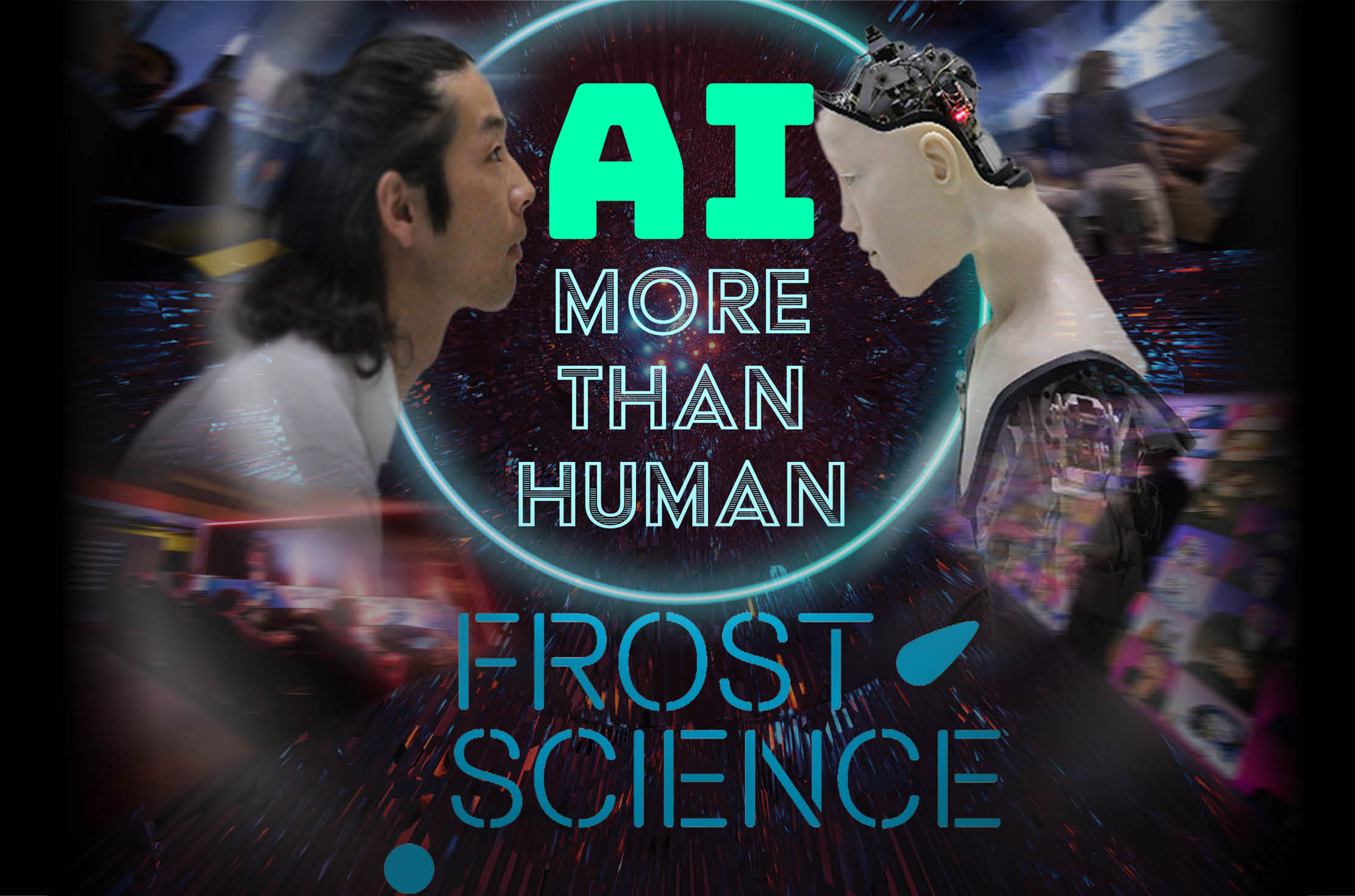
A black and white movie clip of Frankenstein’s monster flickers against the wall in Detlef Weitz and Stefan Hurtig’s “AE/MAETH,” one of the works in AI: More Than Human at The Phillip and Patricia Frost Museum of Science through September 1, 2025.
You know Mary Shelley’s fictitious artificial intelligence origin story of the brilliant Dr. Frankenstein who creates life but then loses control over his “monster.” But what if he didn’t and what if his creation had the ability to benefit all humankind?
AI: More Than Human invites you to ponder these questions as you interact with machines and digital installations that utilize AI in this captivating exhibition sponsored locally by Amazon, the company that brought Alexa into our welcoming homes.
“I hope guests leave the exhibition with a sense of curiosity and an openness to learn more and feel empowered in their ability to use AI,” said Dr. Analisa Duran, Knight Sr. Director of Education at Frost Science. “AI is shaping our future. It is currently and will continue to solve a lot of real world, complex problems apart from using ChatGPT to answer a question.”
Curated and organized by the City of London’s Barbican Centre and co-produced by Groningen Forum, Netherlands, the exhibition contains artifacts from such groundbreaking advancements as Eliza (one of the world’s first Chatbots), circuit boards from IBM’s Deep Blue Computer that beat chess grandmaster Garry Kasparov, the podium from which IBM’s Watson computer defeated Jeopardy! champs Brad Rutter and Ken Jennings, and, yes, even a first generation Roomba.
You’ll find replicas of the German WWII Enigma machine that the Nazis used to send secret messages and the Bombe machine developed by Alan Turing that decoded those missives and helped win the war. There are also letters to and from Turing, a legendary figure in both science and LGBTQA+ history.
Convicted in 1952 of gross indecency for a lewd act with a male person, Turing lost his security clearance and was forced as a gay man to endure chemical castration before taking his own life two years later. Now recognized as the father of computer science, Turing’s dramatic story has been told on film by Derek Jacobi and Benedict Cumberbatch and, today, the UK’s National Institute for Data Science and Artificial Intelligence bears his name.
While Turing’s tragic fate doesn’t say much for human intelligence in the mid-20th century, AI: More Than Human takes the long view with items dating as far back as 14500 BCE.
The exhibition is organized in four parts beginning with “The Dream of AI,” examining its origins through the centuries as people imbued non-living things with human or superhuman traits through religion, science, mathematics and philosophy.
Duran admitted she initially found this component to be a surprise. “At its core, with AI we’re trying to mimic what it’s like to be human. Today we do that through technology, but in the past that was done through religion and philosophy. This helped me think about AI more as a concept versus technology.”

Turing’s achievements are in the next section, “Mind Machines,” that charts AI’s development. Discover how a machine learns and associates words through “Waterfall of Meaning” by Google PAIR. Enter a word and watch the machine’s algorithms cascade forth a river of nouns and adjectives as it works to determine the word’s meaning to ultimately classify it as male or female, good or bad, and machine or human.
As you begin to worry that machines will take over, you may need an emotional support animal and Sony has just the thing by inviting you to play with its robotic puppy, aibo.
“I love that he acts like a dog and you can train him as he learns and remembers you,” Duran raved about a part of the exhibition to which she returns again and again. “You can build a relationship with him, and I think that’s really cool.”
The following “Data Worlds” section delves into the ethical questions raised by AI’s adoption and none more so than “Gender Shades,” a project by Dr. Joy Buolamwini examining racial and gender bias in facial recognition software. Spoiler alert: software has not advanced beyond a two-gender classification.
The good vs evil call on AI ethics is a hard one as you come upon a giant reproduction of a 2015 letter signed by the world’s technology leaders urging a ban on autonomous weapons that resides next to the “Strike Tracker Project,” created by Amnesty Decoders that successfully crowdsourced digital data to uncover human rights violations.
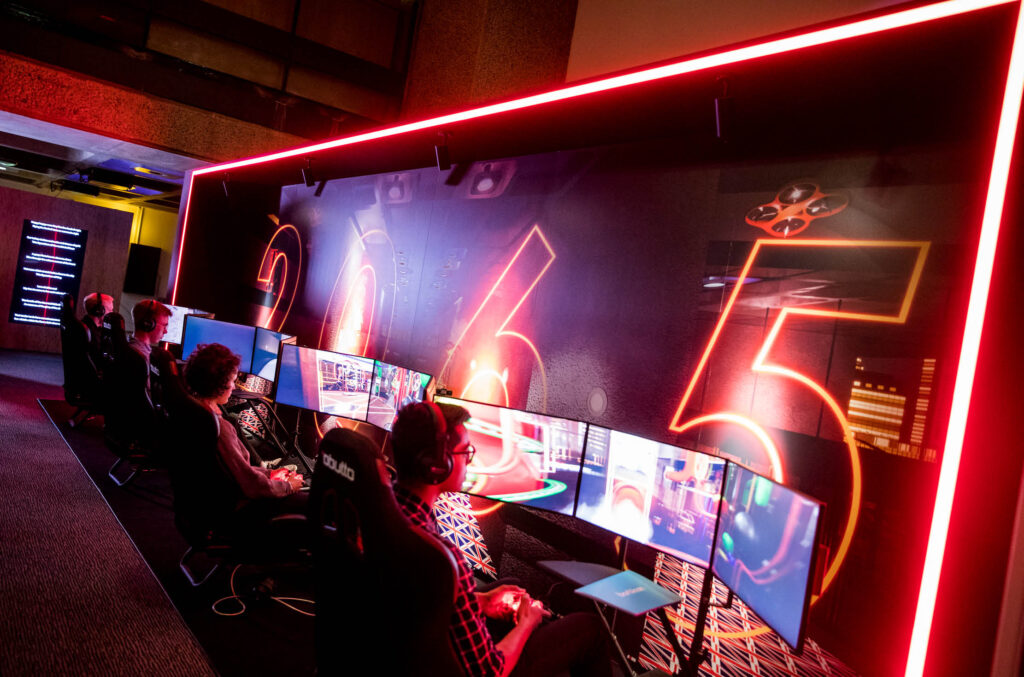
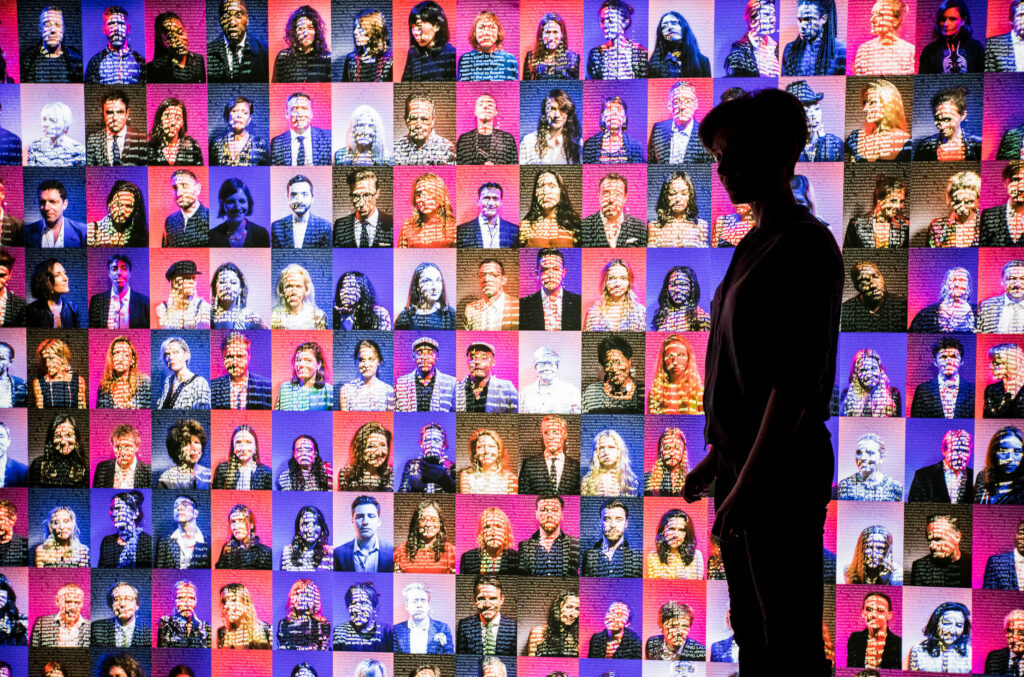
Adhering to strict ethical standards itself, the exhibit uses closed data sets not connected to any network and which will not be saved or used in any way, which leaves you free to play in the interactive exhibits. Create a synthetic version of yourself with Universal Everything’s “Future You” or play the role of AI in Lawrence Lek’s video game “2065.” Next, get behind the steering wheel to help improve facial recognition software in Affectiva’s interactive “Affectiva Automotive AI” before you create art by stepping into an AI photo booth with Es Devlin’s “PoemPortraits.”
“You go inside and give the system one word, any word you’d like,” Duran explained, “It’ll take a photo of you, and then it will create a poem with that word and overlay that poem on the image of your face. It adds words that other people have given to the system to your poem so it’s a collective community experience.”
The exhibition culminates with “Endless Evolution” which peers into IA’s future. Justine Emard’s interactive video installation “Co(AI)xistence” explores communication between humans and machines while close by you can smell a plant that is now extinct. Among the not-so-futurist marvels is “3D Bioprinted Organ Scaffolds” from Wake Forest Institute for Regenerative Medicine depicting how AI is growing human organs in the laboratory.
Contemplating the overall effect of AI: More Than Human, Duran said, “It challenges us to think critically about AI. It doesn’t answer all of our questions because it’s meant to encourage guests to explore those answers internally and have conversations with their peers. AI is rapidly growing. It’s going to shape our future, who we are and what we are. What we do taking in these considerations and finding solutions is going to be paramount.”