
By Denny Patterson
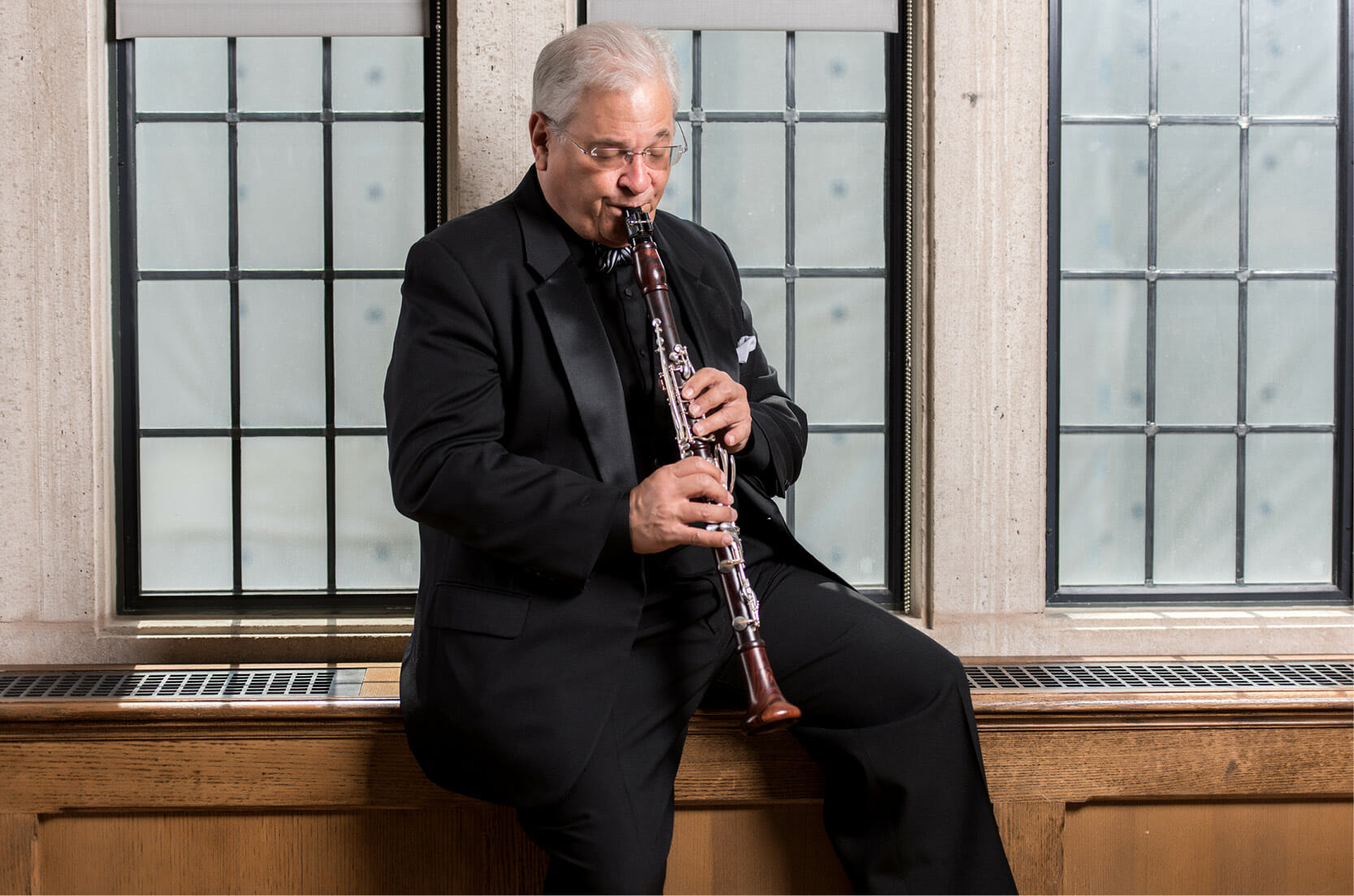
The South Florida Symphony Orchestra’s 2021-2022 season is coming to an end, and it’s finale concert will include Gustav Mahler’s fourth movement of his Fifth Symphony, a love note to his future wife, and Aaron Copland’s Clarinet Concerto, featuring acclaimed clarinetist and artistic director David Shifrin.
Making his debut on the SFSO stage, Shifrin is an Avery Fisher Prize recipient who is in constant demand as an orchestral soloist, recitalist, and chamber music collaborator. Appearing and playing with orchestras all over the world, and receiving several awards and accolades for his work, he has been instrumental in broadening the repertoire for clarinet by commissioning and championing the works of 20th- and 21st-century American composers.
Shifrin caught up with OutClique to talk more about performing with the SFSO and his love for the clarinet.
Denny Patterson: This will be your first time playing with the SFSO. What are you looking forward to the most about it?
David Shifrin: It’ll be a new experience. I don’t know anyone in the orchestra, but I’ve heard very good things. I heard a recording of the orchestra, and I always love playing Aaron Copland’s Clarinet Concerto, so it’ll be a pleasure to play it again. I haven’t done very many concerto concerts during COVID. I’m looking forward to getting out there with them.
DP: Can you tell us more about Copland’s Clarinet Concerto and what makes it so special?
DS: It was written for the superstar clarinetist Benny Goodman, who did more for our instrument in the 20th century in every way than anyone else. Everybody knew him as the “King of Swing” and probably one of the biggest celebrities of the mid-20th century, but he took a very serious interest in the classical repertoire and notably performed Mozart and played chamber music with the Budapest Quartet. Most importantly, he commissioned all the leading composers of the time that he could persuade to write music for the clarinet, and that included Bartók, Hindemith, and many others, but probably the most successful and often performed larger piece is this Copeland concerto that Copeland wrote for Benny Goodman in 1948. He tried to capture both his own signature voice and the qualities of jazz that would feature the specialty of Benny Goodman, and it’s that kind of dual edged approach to this piece that really makes it unique.
DP: Have you always had a passion for music?
DS: I have. I grew up hearing music in my home. I’m not from a family of professional musicians, but there were always opera recordings, violin recordings being played, and I wanted to play an instrument. What inspired me to be a clarinetist was seeing a movie from the 1950s about Benny Goodman.
DP: What do you hope audiences take away from your performances?
DS: I hope they get a taste of the very, very special approach to music making that Aaron Copland had. It’s been described so often as distinctively American, and whatever that means, you’ll hear in the juxtaposition his use of harmony, his use of very open phrasing and long lines in expressive passages, and his very frequent use of jazz idioms. You’ll hear how it all comes together right in the middle of the piece when the clarinet plays all alone for a couple minutes after an extended, expansive, expressive, slow introduction. The clarinet is left all by itself, and it gradually heats up and transitions to the more frenetic, energetic, quirky, jazz-influenced section.
DP: You have already achieved so much throughout your life and career, but are there any future goals you would like to accomplish as a clarinetist and artistic director?
DS: As a clarinetist, it’s always a self improvement course. You have to work very hard just to keep the level that you may have already achieved. So, staying in shape and practicing regularly is important. For me, the goals are to keep the highest level of performance in the repertoire that I know, continue to learn new pieces that I have not done before, and in the great tradition of people like Benny Goodman, try to influence composers of our time to write new works.

DP: For any aspiring clarinetist, what advice can you offer?
DS: Practice and listen to great music. Not just clarinet music. Listen to opera, great symphonic repertoire, chamber music, and composers like Bach, who is one of the great geniuses of all time, but unfortunately, he never wrote anything specifically for the clarinet. However, I encourage all musicians to learn his music and transcribe it for the clarinet or play it on the piano.
DP: One of your biggest achievements is being one of only three wind players to have been awarded the Avery Fisher Prize since the award’s inception in 1974. What an honor that must have been for you.
DS: It was a great thrill, but I must add that since that was put in my bio, we’ve welcomed another clarinetist. The great Anthony McGill, who is the principal clarinetist of the New York Philharmonic. He was awarded the Fisher Prize last year, so we are in good company.
DP: You have also received Grammy Award nominations for three different recordings. Do you have any upcoming projects or albums in the works?
DS: It’s funny you should mention that. I have a real affection for an album that was just released this year, music of Francis Poulenc, and coincidentally, the anchor work on that recording is his Sonata for Clarinet and Piano, which was premiered by Benny Goodman. It was a seminal work for the clarinet in that Poulenc was supposed to play the premiere in Carnegie Hall with Benny Goodman, and unfortunately, he became very ill and never performed again. They had to get a young, talented pianist composer to take his place, and that was Leonard Bernstein, who has also written for the clarinet. Not for Benny Goodman, but the mid-20th century was a really good period for recognizing the different qualities of the clarinet. So many great composers wrote for clarinet.
DP: Before we wrap up, is there anything else you would like to mention or plug?
DS: I’m just very happy to be coming down there to play for your audience in South Florida.
To connect and stay up-to-date with Shifrin, visit his official website, DavidShifrin.com. Masterworks V will be performed at The Parker on April 27, 2022 at 7:30PM. For more information and to purchase tickets, visit SouthFloridaSymphony.org, or call (954) 522-8445.


