By Mike Jeknavorian | www.MikeJeknavorian.com
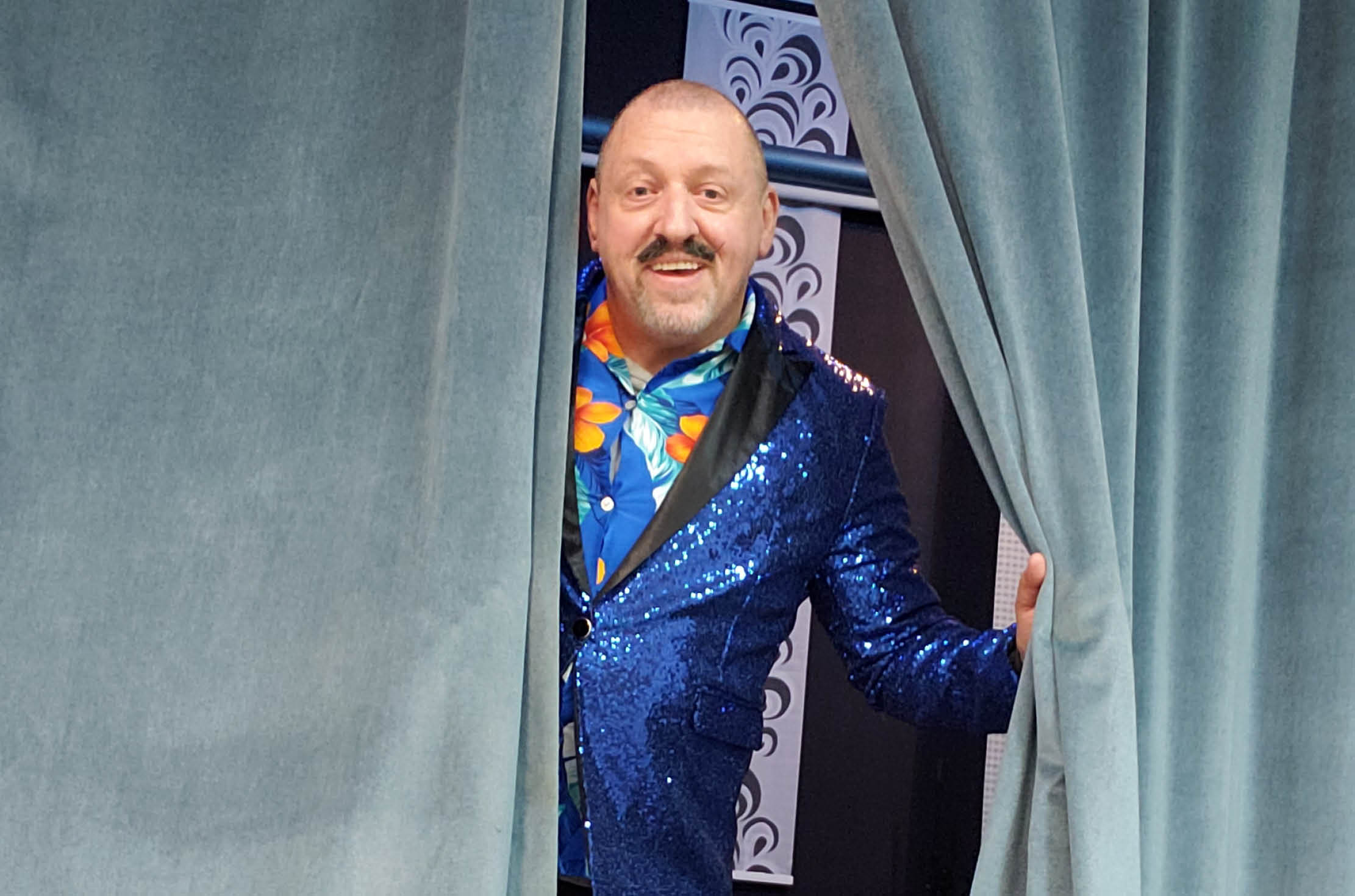
Hi diddly dee, an actor’s life for me, and, to add, a director’s life. Not only does Ed Sparan’s tenure as a theater and cabaret performer span several decades, but his experience as a writer/director is almost just as long. From New York City to San Francisco, and now in South Florida, Sparan’s career is prolific. I sat down with Sparan to discuss his career in the performing arts, including founding his new theater, the Epiphany Theater.
Mike Jeknavorian: To begin, you’re from Bridgeport, Connecticut, right?
Ed Sparan: I grew up in the Connecticut areas of Milford, Stratford, and Bridgeport. I had a very basic and quiet suburbia. I was a shy, fat, quiet kid, but when I was 15 I caught some kids robbing my parent’s house. One kid stabbed me and we went to court. Because I got him in trouble, six months later he sent some bullies after me and they beat my face. My face was repaired at the time, but years later, at age 39, that injury caused damage to my eyes. I was blind for four years. I had surgeries and my blindness is now corrected to 20/40 vision.
MJ: You moved to New York City in the 1980s, right after high school. What was New York like then?
ES: New York back then…? It’s impossible to tell you in a few words. Simply put, it was the highest of highs and the lowest of lows. New York was acceptable, diverse, original, and artsy, but it was also the decade of the AIDS crisis. I saw hundreds of friends die. Going to bed with someone back then was a life-or-death situation.
MJ: What was life like for you specifically when you first got to New York?
ES: I went to school in Columbus Circle, and after school I would walk through Times Square. Broadway was here and I could touch it. I saw the musical Dreamgirls 18 times. It’s my favorite show, ever, because of the creativity and artistry of the cast and Michael Bennett. Also because I could relate to the character of Effie, being talented, but overweight, and being rejected. As a poor, hungry, struggling actor in New York, I lost 80 pounds the first year and finally found my true self. My confidence.
MJ: What was your professional career like in New York City?
ES: I enjoyed doing cabarets because it was all “me” on stage, up-close and personal, and I was entertaining and making people laugh in a time when it was so difficult to laugh. Laughter is the best medicine, even today.
MJ: You were in the musical, A Chorus Line? What was that like.
ES: I was in the show in 1986, 12 years into its run. An actor I knew was leaving the show, so he told me they were looking for replacements. He played Greg in it, the gay upper-east-sider. I was a great singer, but just an “okay” dancer. I was openly gay, and it was easy for me to grasp the character of a gay preppy from Connecticut. I also feel that I got the job because of AIDS. Back then in 1986, some would be quiet about being gay, and most of the gay community was gone because of the AIDS crisis. Few gay men auditioned for roles like that at that time. I had a great fantastic time for the first few weeks, but quickly it became work and a job. And it was a lot of work keeping up with those other dancers, who were better than me. When my contract was up, I was out, and I felt like I failed. It took me a long time to get over that rejection.
MJ: What celebrity interaction in New York stands out to you?
ES: Theatre celebrities most people would not know meant a lot to me. When I was a student in New York, I did meet Katherine Hepburn, albeit illegally. My friend in school, Eileen, was a big fan of Katherine Hepburn, and Hepburn was doing a play at The Barrymore Theatre. I borrowed a pair of overalls from the janitor at school and posed as a delivery guy. When I got to the theatre I said that I was there to bring Ms. Hepburn a package, and I actually got into her dressing room. When I got in, I apologized and told her I was not a delivery guy. I told her I had a picture for my friend and asked if she could sign it. Ms. Hepburn was very nice, but she explained to me that she could not sign unauthorized pictures that were not issued by the studio. Then she opened a small drawer and wrote a note on her personal stationary. The note said, “Good luck on your graduation Eileen. I am sorry I am not allowed to sign pictures.” Signed, “Katherine Haughton Hepburn.” Eileen hung the note in her living room, and then later on in her office at ABC studios.
MJ: Then you moved to San Francisco in the 1990s?
ES: I had spent a decade in New York City and I moved to San Francisco in January 1990. At that time my boyfriend Roger died from AIDS. With that, and being fed up with New York City, I got as far away as I could. After my older sister outed me to my parents, I drove my motorcycle to San Francisco, and within 48 hours I had a job in a gay bar and a fabulous apartment. Within a year I was the Artistic Director of The PWA Theatre, The “Persons With AIDS” Theatre. They did HIV support groups, and it was my job to take those stories and create theatre about HIV. It helped people heal to tell their stories, and it helped people who saw those plays to understand.

MJ: What story at The PWA Theatre stands out?
ES: I created a play there called Bert’s Big Bed. It was a story of Tim who has trouble telling his partner Mark that he has HIV. Bert acts as a kind of a cyranno to help Tim tell Mark. It was well-received in San Francisco, and it was done in other cities regionally. I was the Director and Author, and I was negative at the time, but the play was about HIV, and the actors were also positive. One of the actors at one of the rehearsals made a comment and said, “What do you know of our pain, Mary. You’re not on the bus!” This statement troubled me for a while. Then I came to realize that as they get off the bus, I will still be driving it. I am the driver. I go forward. I knew I could make a difference. This situation and this show solidified me to always be an activist. To always fight, and to never look back. We’ll be doing this play as part of the Epiphany’s 2020 season.
MJ: Now you live in South Florida. In what capacity were you involved with the World AIDS Museum that’s here?
ES: I was always an activist and involved in my community, but it was a shock to me when at age 39 I found out that I had HIV. I did HIV-related artwork and found out about a possible museum at a support group. I was with the project from the beginning, and when the doors opened in May 2014, I left my cruise ship job and became the only employee of the museum, the manager. I worked my butt off. I loved my job, but Larry Kramer was the high point. I did a lot of the work putting together the show, and all of the work putting the exhibit together. I was awake for three days creating it. Larry arrived, and we gave him a tour of the museum-history exhibit. Later on people were talking, and I was alone with Larry in the ACT UP exhibit gallery. He asked me where I got the info and the pictures and how I put together the exhibit. He was very impressed; the exhibit made a big impact on him. He thought the past few years that people forgot about him. He was very moved by the exhibit, seeing the impact he had on the community. He had doubts. I told him that he did have an impact on the community. I told him that he changed my life. He squeezed my forearm and said to me, “You are a treasure.” We both began to cry. I made Larry Kramer cry. I was lucky to have met the man and to share a small, special moment with him. The next day at Sunshine Cathedral his event was sold out.
MJ: You recently founded the Epiphany Theatre in South Florida. How did your first few shows go?
ES: The first show we did was Gay Amnesia. It was a simple, easy, charming show with a good message. We did a few updates on it. The audience enjoyed it. We did Heroes at The Broward Main Library Auditorium, and last year we did Die Mommie Die at Empire Stage. I directed it and played the female lead of Angela Arden.
MJ: How do you go about selecting shows for the theatre?
ES: I guess I choose shows that are special to me and that I feel have a message to tell the audience. We’re doing a number of shows for our 2020 season. We’re doing the British play, Stepping Out. It’s about ladies of a certain age that take a tap dance class, but instead of tap they learn a lot about themselves and friendship. Forgotten, Unforgettable Broadway! is a unique musical review that we’re doing. The songs in it are ones that you may know. They’re great songs from shows that flopped and were forgotten, but the songs live on. There are songs from shows like Dance a Little Closer, Minnie’s Boys, Breakfast at Tiffany’s, and Carrie. We’ll also be doing my play, Bert’s Big Bed. And finally, we’re going to do a rare show, the Kander and Ebb show, The Rink.
MJ: The Rink is arguable an ambitious piece. If you foresee obstacles with the show, how do you plan to overcome them?
ES: The Rink was a charming show with great music. I need two strong female singers, and five guys who can sing and roller skate. I like the challenge. I’m going to present the show in a creative way. Come see it to find out. Ultimately, it’s a show about a mother and daughter, struggling with their past, their family, and acceptance. The daughter wants acceptance, but to get acceptance you have to look first at the other person to understand where they’re coming from and why they’re having trouble accepting you. In people, you have to overlook their flaws and to find the good in them. As a director, same thing. I’ll have to overlook the flaws in the show and highlight the good parts. True, no one has ever attempted this show before. I can’t wait to do it! I love the challenge; bring it!
MJ: Finally, a fun question. What’s the craziest thing that has ever happened to you on stage?
ES: Crazy things on stage…? Well, in cabaret, the worst show I ever did was at a lesbian bar in Bridgeport, Connecticut. Before I went on, there was a 300-pound Marilyn Monroe impersonator. When she was on stage, they booed her, then three girls got on stage and beat her up. I went on after that. The audience was cordial to me, but after my show was over I left so fast that I ran out of there without getting paid!
To learn more about the Epiphany Theatre and their upcoming shows, visit their page at www.Facebook.com/EpiphanyTheatre.