
Champion and Leader of the Arts
By Charles Baran
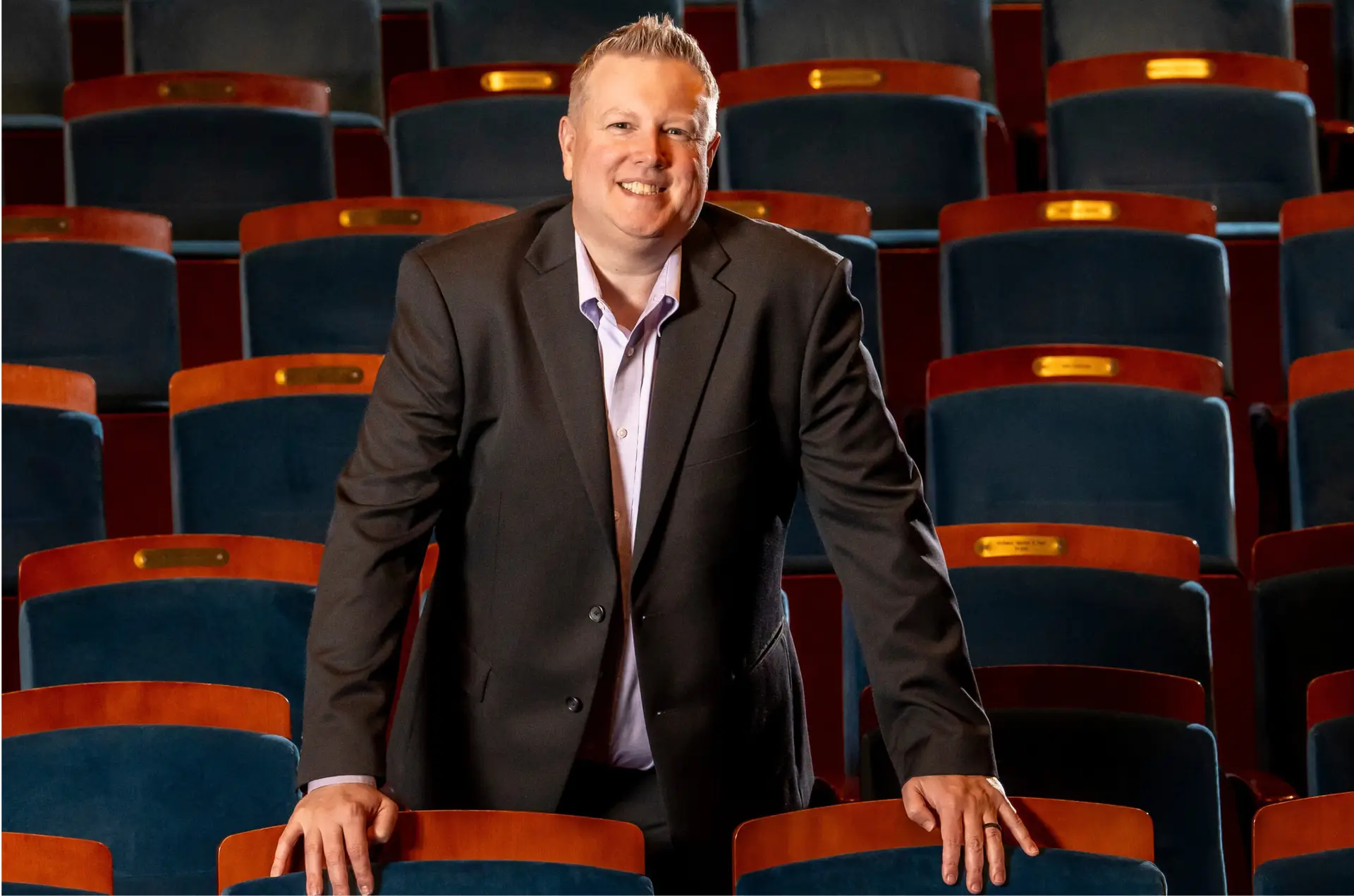
The Broward Center recently welcomed a new President and CEO, Ty Sutton, who brings with him not only a wealth of experience from running top arts and cultural organizations in the country but a much-needed, forward way of thinking about an industry that is constantly in flux with ever changing technology and new forms of entertainment. Charming and personable, his outlook is decidedly refreshing, his energy contagious and his spirit unstoppable.
Charles Baran: Hi Ty! I know it’s a little late, but welcome to Florida!
Ty Sutton: My family just arrived and settled in, so it feels like I just got here too, so thank you! My wife and two kids are really excited to take advantage of all the great things this area has to offer. We even took an airboat ride in the Everglades!
Charles Baran: You bring 20 years of performing arts leadership experience to the Broward Center. What exciting plans do you have?
Ty Sutton: A lot of our traditional art forms are struggling to find audiences. So, my job is really to look at what’s next. My kids don’t want what I wanted in the ‘80s. So, we need to look forward, looking out perhaps twenty or thirty years, and be a nimble, adaptable organization that is open to what art is, knowing that it might be different from what it’s been. I want to meet people where they are, invite them in. I want them to participate and be part of this great community we have here at the Broward Center that brings people together to share something, but what that something is will change over time.
Charles Baran: What are the challenges of coming into an organization as well established as the Broward Center?
Ty Sutton: I come with a unique standpoint as this is now the fifth performing arts center I’ve run. In the ‘80s a group of citizens here in South Florida had this vision for a grand performing arts and cultural facility to put Fort Lauderdale on the map and they were incredibly successful. They did everything they said they would — which is very rare. And so, for me, the challenges are to find a path forward, a vision for the future, to take all the things that have been so incredibly successful, keeping many of those things and making sure we take care of them and also to have the courage to stop doing some of the things that really aren’t as valid. That’s a challenge in most businesses, whether they are for-profit or nonprofit.
For example, if we look at ballet, opera and symphony, there are some serious challenges to the core performing arts right now all across the country, as well as some great opportunities. It’s about having the courage to look ahead at what the future is and try new things. And not be afraid to fail. It’s okay to fail when you’re trying new things. It’s not failure, it’s just a first attempt at learning.
Charles Baran: You relocated to Florida after a six-year tenure at Dayton Live. What were your highlights of your time at Dayton and do you intend to bring any of those ideas or programs to all of us down here in Fort Lauderdale?
Ty Sutton: My time in Dayton was great. I took over an organization that was really at a crossroads. Dayton Live is a nonprofit that owns very similar facilities to the Broward Center. But unlike the Broward Center, it had many financial challenges and a community that had been shrinking for many years. The lessons I take away from my time there are how to work with an organization that means a lot to the community. How to make sure we’re engaging with the diverse community here in Broward County and South Florida. So many people live here part-year and there are also a large number of tourists. The lessons I’ve learned relate to how you make sure you are part of the community. How you listen to and partner with people. It takes others to create programs, and we play a key role in putting their talent on stages. How do we serve as an incubator for people who have never had a voice? How do we make sure the nonprofits get the business knowledge they need to run their organizations well so they’re not constantly in a fundraising fight? How do we use our political capital to support the creative industry we’re part of and be a voice for lots of different people? The lessons I take are how to lead in the arts, how to be a champion, how to work with people from all diverse walks of life from the tiny organizations where it’s a single person who has an idea to the very large cultural institutions and be a partner to them.
Charles Baran: Has the elimination of $32 million in arts funding by Ron DeSantis impacted the Broward Center in any way?
Ty Sutton: There is an impact for us but because our budget is so large, it was a smaller financial impact than other organizations felt. And it’s going to be a tough year for a lot of those organizations. I’ve unfortunately been through that many times. So, the lesson is, we need to tell the story of the creative sector better to get public support and also work with others that are passionate about the arts like many of South Florida’s private foundations. I think what people miss sometimes is the effect that creativity has on young people and the impact of the arts on education. The arts can be a key to educational success and a vital economic driver. The bigger issue is how do we work from a place of strength in the future and how do we work collectively with the bigger arts organizations to make the case. I’m in a lot of one-on-one meetings to talk about how we can work together to fill some of this gap. I belong to a group that includes the five largest performing arts centers in Florida: the Kravis Center in West Palm, the Arsht Center in Miami, the Straz Center in Tampa, the Dr. Phillips Center in Orlando and the Broward Center. We’re working on a lot of these issues to identify ways to help our smaller arts organizations in a positive way. The CEOs of those organizations are all good friends of mine so it was easy to walk in and say, “What are we working on together?” They were already working to address a lot of these issues and it’s great to see this level of industry collaboration.
With regard to our specific Broward County community, when they do all these surveys, Fort Lauderdale has consistently been listed as a top place to live and they specifically cite the arts. Not every community makes that commitment. It is the families, the young people, the people with special needs, the retired community, people from all walks of life that are impacted positively when the arts are strong in a community. I think sometimes “we” as an industry haven’t told that story very well. We focus on the art rather than all the things that the arts create. The sense of wellbeing, the sense of place, the sense of belonging to a community that those things bring. It translates into people wanting to be a part of it, wanting to be in that community or that state. This part rests on us, the people that manage the arts, to go out and tell the story in a really understandable way instead of focusing primarily on what actually happens on stage.
Charles Baran: The fall season is upon us, so you’ll be having a lot of audience members coming down. What are a few highlights of the upcoming Broward season?
Ty Sutton: As of right now, we have between five and six hundred confirmed performances coming up. From the Broadway in Fort Lauderdale series we have MJ, The Musical. I saw it in New York as a Tony voter, and Michael’s story, which is a challenging one, was told so incredibly well. It’s written by Lynn Nottage who won the Pulitzer for drama twice, plus there’s the brilliant music and fantastic technical aspects. It’s a great show. Then at the tail end of the season, we have Shucked which is super-funny and lots of fun. People are going to have a great time. We have so many comedians of every kind, like Nikki Glaser. We sold out her first performance and added another and that sold out, too! I love being in a place that supports so many different styles. I’m excited about Ben Folds coming here with his Paper Airplane Request Tour. I love Ben Folds. A brilliant performer and a real champion of the arts. We have the MOMIX dance troupe doing their incredible ALICE piece, inspired by “Alice in Wonderland.” And I love what Slow Burn Theatre Company is doing. The Witches of Eastwick is very new and something very few people have ever seen done. Then they’re doing something as heavy as Parade which was incredible on Broadway. They’ll do a really great job telling that story about people who are not only persecuted but also not understood. Steven Page, formerly of the Barenaked Ladies is coming to do a solo show at The Parker for our Ghost Light Society Soirée, where he’ll perform a private set featuring some of the Barenaked Ladies’ hit songs.
Charles Baran: What’s the most rewarding part of your job?
Ty Sutton: I think the education programs. Among our peers, the Broward Center has one of the strongest commitments to education in the country. Another thing I find rewarding is connecting people. We live in a more and more isolated and fractured society. I think we thought technology would connect us, but what it’s done is isolate us. People work in remote jobs now which means they work alone, they don’t have to go out, they don’t have to talk or socialize with other people, and I see it with our kids; they sit and text each other on the same couch. We’re more fractured politically and ideologically than at any time in our history. Arts bring people together even if they have nothing else in common. It’s more and more needed. Studies have shown that when you go to a symphony, your heart beats collectively with everyone else. In a more isolated world, what we do together matters even more than it ever has. Giving people these opportunities to have an experience with somebody else is a positive thing and is what I value the most about what we do.
Charles Baran: Tell me more about these education programs.
Ty Sutton: The Broward Center runs the largest, free arts-in-education program in the country. We partner directly with Broward County public schools. We run a program called the SEAS Program (Student Enrichment Through The Arts). We also work a lot with the neurodivergent community, people who are somewhere on the autism spectrum or may have other developmental issues. We have kids here every day in summer camps working with educators, putting on musicals. In total we touch over 100,000 students’ lives a year. And that’s something the Broward Center has done quietly all these years. When they did the renovations in 2014, they added a full education center that is pretty much in use every day of the year. Education is really central to what we do. To see a robust education program here that is so inclusive is really a fantastic thing and one that we will keep growing. We have an amazing array of adult classes, too. It’s a great combination of things.
Charles Baran: Thank you for your time, Ty. It’s been an inspirational chat!
Ty Sutton: You’re welcome, Charles. I look forward to seeing you at the Broward Center this season.


