
January 26, 2024
The Parker | www.ParkerPlayhouse.com
By Denny Patterson
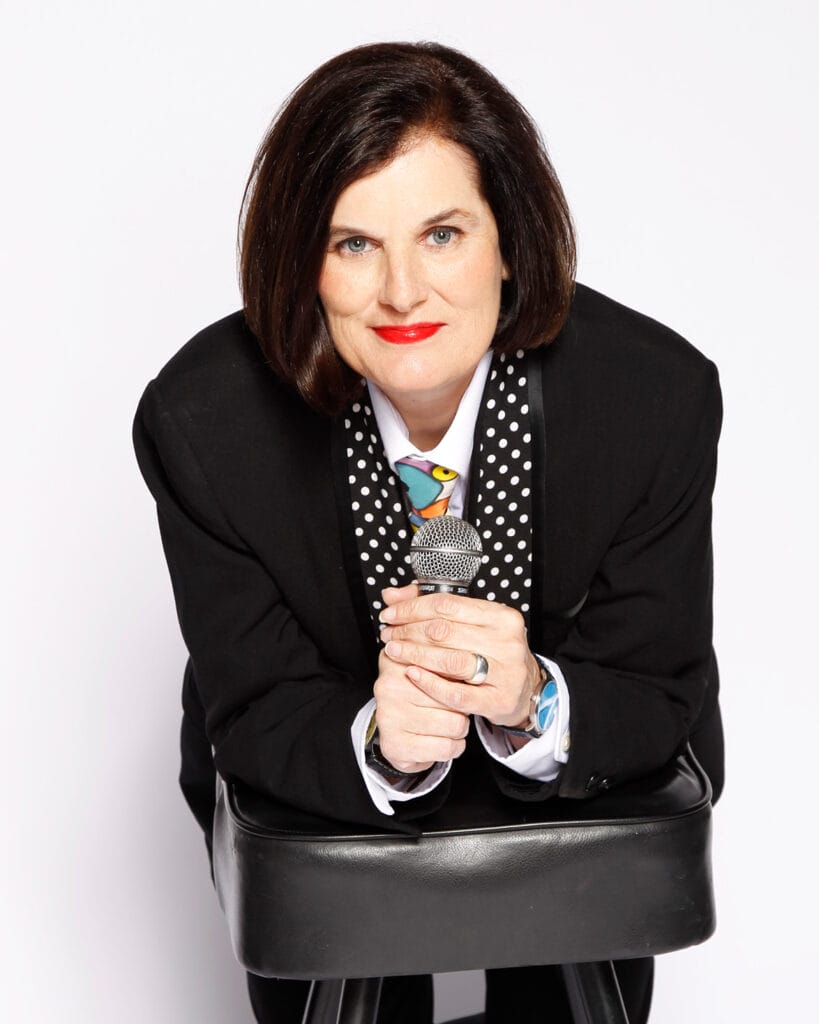
As one of the country’s most influential stand-up comedians of our time, Paula Poundstone is known for her smart, observational humor and spontaneous wit.
Starting out at open-mic clubs in the late 1970s, her career has ultimately led her to not only being a professional comedian and storyteller, but also an actress, author, interviewer, and commentator. Poundstone awards and accolades make a long list, but some of her biggest accomplishments include performing several one-hour HBO comedy specials, providing backstage commentary during the 1992 presidential election on The Tonight Show with Jay Leno, being the first woman to perform stand-up comedy at a White House Correspondents Dinner, and hosting a successful comedy podcast called Nobody Listens to Paula Poundstone.
Poundstone will be coming back to South Florida’s Parker Playhouse for a one-night only set on January 26, 2024, and OutClique recently caught up with her to talk more about it.
Denny Patterson: Let me begin by asking, how excited are you to perform in South Florida again?
Paula Poundstone: I’m very excited! I haven’t been to Florida in a while, and I’m glad occasionally on a weather map that it’s still there. It could go skittering off into the ocean any minute.
Denny Patterson: What can audiences expect from this show?
Paula Poundstone: Well, there’s no mosh pit, so no one will get hurt physically, but my act is largely autobiographical. I talk a lot about traveling, and everybody makes fun of comics for talking about airplane travel, but hey, it’s a big part of our lives. I don’t have a specific set, but my favorite part of the night is just talking to the audience. I do the time honored ‘what do you do for a living?,’ and this way, little biographies of audience members emerge and I use that to set my sails. So, a lot of times, I really don’t know what I’m going to talk about until I talk to somebody else there.
Denny Patterson: Yeah, your sets usually involve a lot of audience interaction and crowd work. Can that be tough to do at times?
Paula Poundstone: No, it’s mostly the fun part of the night. If there’s somebody who I feel like I can’t make heads or tails out of, or it seems somehow fractious, I just turn my attention elsewhere.
Denny Patterson: What do you always hope audiences take away from your comedy shows?
Paula Poundstone: A sense of belonging. I hope they get happy chemical hits in their brain from the laughter, which by the way, leads to better health outcomes as well. You know, it’s funny, the stay at home orders from COVID was almost like an odd social experiment in many ways. One of the things, and frankly, I started taking this for granted as an audience member myself, is sitting among a group of strangers, maybe community members, but not necessarily people you know, and watch something like a music concert, play, movie, comedy show, or whatever, and having a shared emotional response. It makes you feel human, especially when a comic is telling a story that is somehow relatable. When I was raising kids, raising kids can be very lonely, and in my experience, the whole time I was doing it, I kept thinking I was doing everything wrong. When I would go in front of a crowd and tell a story about it, people would laugh, but it was with what I call recognition laughter. Where they go, oh my God, that happened to us. When you’re able to laugh at stuff with other people, it is so reassuring. I think being a part of any audience is a terrific thing.
Denny Patterson: You started doing stand-up comedy at open-mic nights in Boston in 1979. How did this journey initially begin for you, and has entertaining always been your passion?
Paula Poundstone: Yeah, I wanted to be a comic-actress when I was growing up, okay. I was the youngest in my family, so my mother used to get the older kids off to school in the morning before I was of school age, then she would go back to bed. So, I was just sort of left to wander. We lived in a small town in Massachusetts, it’s not like I was out in the mean streets of the city, but I was just sort of left to wander around, and I would eventually find myself in front of the black and white television. In the morning, there was Captain Kangaroo and Romper Room, which I wasn’t particularly a fan of either, but some stations showed The Three Stooges and I Love Lucy reruns. I always tell people the Three Stooges and Lucille Ball were my babysitters when I was little (laughs). So, I saw myself being a comic-actress like Lucille Ball, and then along came Carol Burnett, Lily Tomlin, Gilda Radner, and Mary Tyler Moore, but I had no idea how one entered that world. When I was living in Boston bussing tables for a living, somebody else entirely started a stand-up circuit. Obviously, stand-up comedy had been around for a long time prior to that, but this was sort of a renaissance that took place. It was a red hot commodity in the 1980s, and it was so much fun to do.
Denny Patterson: What particularly drew you to the observational brand of comedy?
Paula Poundstone: Just observing. When I see something funny, I point it out. I was the kid in the hallway a lot because I was thrown out of the classroom, but laughter is an amazing thing. A sense of humor is this coping mechanism that nature has given us, and I’m not sure if other species have it. Maybe racoons or squirrels, but certainly anything that’s directly related to us like monkeys or chimpanzees. But you have to have a sense of humor to get through life.
Denny Patterson: Unfortunately, several comedians have become victims of cancel culture. Do you believe some topics should be off-limits and never joked about?
Paula Poundstone: I don’t think it’s the topic, but I think it’s the way you wield the topic. I had somebody say to me the other day, it was a friend of a friend that I was getting tickets for, and she said, do you do any jokes about Israel and Hamas? I thought that was such a strange question, but I said no, and it’s not because I’m afraid of the topic. I don’t find a topic and then find a joke. If I had a joke that I thought was really funny on the topic, I’d do it, but there are some topics that just don’t have a lot of funny jokes about. I’m not going to fish around for it. And on that particular topic, I’m so ignorant. There’s a complex history there, but hey, maybe I can even joke about my ignorance about the subject. I remember years ago, somebody asked me if I had jokes on AIDS, like when it first came to be. And I was like, same thing, I don’t. But if something really funny came up about the topic, I guess I would say it, but I’m not fishing around for it. All these years and nothing ever did.
Denny Patterson: What’s new with your podcast, Nobody Listens to Paula Poundstone?
Paula Poundstone: Well, we’ve been doing it for about four years now, and like with anything else, I think it gets better over time. It’s a comedy podcast, obviously, but we do interview people with real information to share, and many of the little segments we do involve relaying some sort of facts about something. It’s been a lot of fun. I do the occasional goofy character, which is something I never would have had the balls to do on stage (laughs). I can only do it there. And I’m not even in the studio with others anymore. I’m by myself in my dwellings, so it’s been fun. I’ve gotten to try some stuff that’s different from my stand-up, and our audience seems to be continuing to grow, which is great.
Denny Patterson: Before we wrap up, are there any other upcoming projects or anything else you’d like to mention or plug?
Paula Poundstone: Nope, I’m just plugging along and doing my thing. I’m out on the road and having the best time with these audiences!
Stay up-to-date and connect with Poundstone by following her on Facebook and Instagram @PaulaPoundstone, or visit PaulaPoundstone.com. For more information and to purchase tickets for her upcoming performance, visit ParkerPlayhouse.com.