By Bishop Durrell Watkins, DMin
August marks Transgender History Month. When we reflect on transgender history, certain pioneering names rightfully take center stage. We remember Christine Jorgensen (1926–1989) whose 1952 gender confirmation surgery made global headlines, launching her lifetime of outspoken advocacy. We honor Marsha P. Johnson (1945–1992), a transgender woman and liberation activist at the heart of the 1969 Stonewall Riots. History also shows us Dr. James Barry (1789–1865), a 19th-century transgender man and British Army surgeon who performed the first successful Cesarean section in Africa where both mother and baby survived. We learn from Michael Dillon (1915–1962), the British physician who became the first transgender man to undergo and chronicle gender confirmation surgery in 1946, and Lili Elbe (1882–1931), the Danish painter whose early 1930s transition in Germany inspired the book and film The Danish Girl.
To this list of historic achievers, it is meaningful to add a religious dimension. Scripture itself invites this expansion. While Genesis tells us that humankind (both male and female) is made in the divine image, St. Paul later proclaims that in Christ “there is neither male nor female.” Furthermore, despite centuries of patriarchal language referring to God as “He,” “Father,” or “Lord,” the only explicit biblical mention of God possessing reproductive anatomy is found in Job 38, which speaks of God’s womb.
Traditionally, Jewish and Christian mysticism view God’s Shekinah (glory) and Ruach (Spirit) as feminine or gender neutral. Several early church theologians referred to the holy Spirit as “Mother,” a phrasing echoed in the apocryphal Gospel of the Hebrews, where Jesus calls the Spirit his mother.
Even the mechanics of biblical creation challenge rigid gender binaries. In Genesis, Eve emerges from a male body without a maternal birth-giver. Conversely, the Gospels describe Jesus as being conceived without a human father. Taken literally, this would mean the masculine-presenting Jesus carried no Y chromosome. If we approach these foundational texts at face value, they inherently feature intersex and nonbinary realities.
Of course, interpreting ancient texts about ultimate reality is always speculative. But the point is clear: transgender, nonbinary, gender-fluid, and intersex individuals are not only natural parts of our world—their essence may also be woven into our sacred stories. Even God, who exists both beyond and inclusive of every human experience, can be beautifully understood as nonbinary.
The “T” in LGBTQIA+ is essential. All boats rise together, and we cannot achieve true liberation by securing justice for only a few letters of our community’s acronym. We are a beautifully diverse family, and every part deserves to be seen, protected, and celebrated. All people are made in the image of a nonbinary God who is love—and who, as love, fiercely embraces every single one of Their children. Praise God!
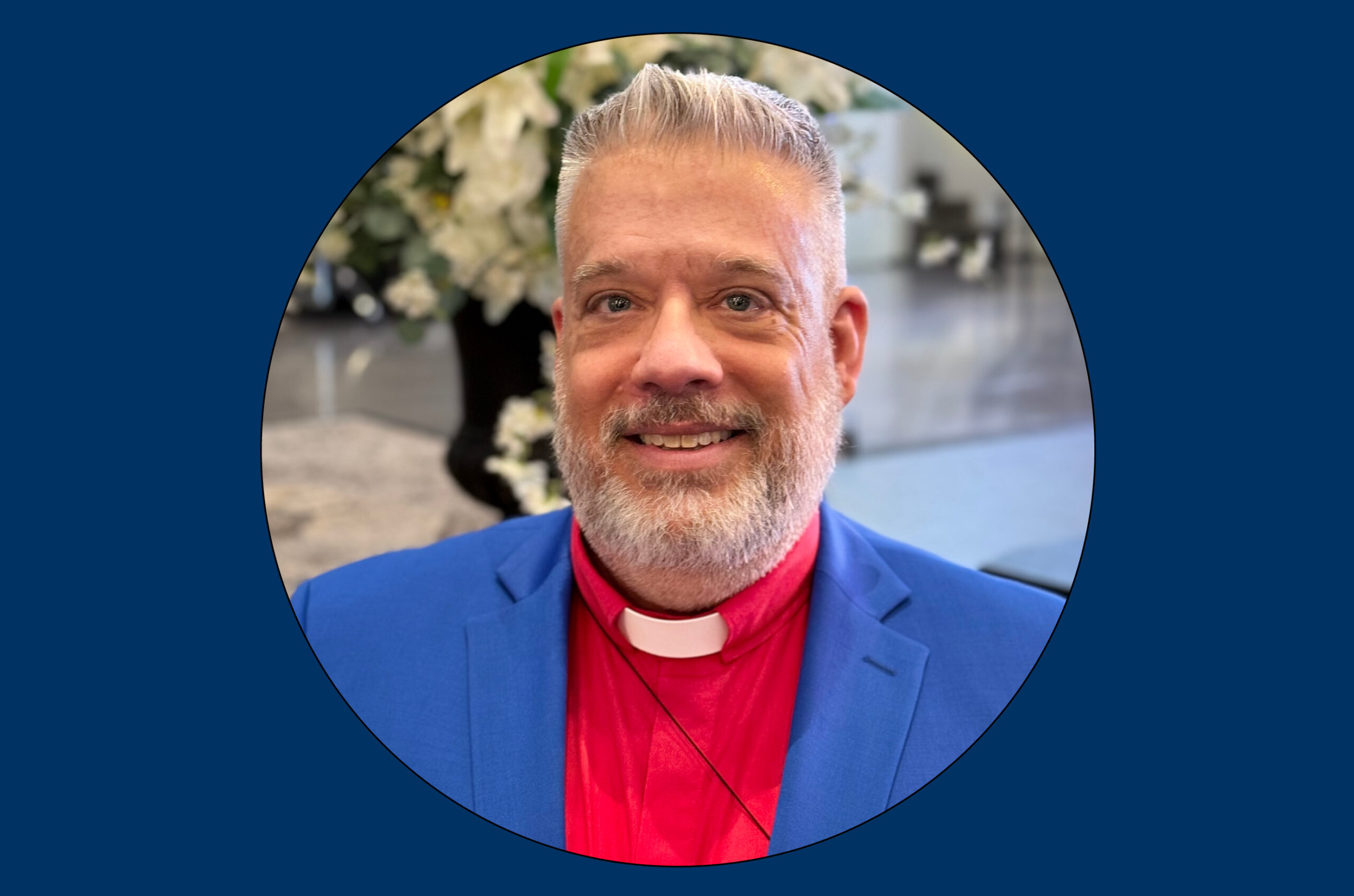
Bishop Durrell Watkins, DMin. is the Senior Minister of the Sunshine Cathedral. Sunday worship is at 9:00 AM and 10:30 AM (10:30 is live streamed on Facebook and YouTube).