FGO brings Frida to the stage
By Erin Dahlgren
It is not every day that a trip to the opera offers such a modern, relevant and culturally educational experience, but Florida Grand Opera’s production of Frida, by renowned composer Robert Xavier Rodriguez delivers all of this and more.
Depicting the life story of well-known Mexican artist, Frida Kahlo, the performance can hardly be described as joyful, considering the tragedies that Kahlo endured throughout her life, but through a carefully constructed and choreographed combination of dance, costume, acting, and of course stunning opera singing, her story is gradually told with a passion and sincerity that is simply captivating.
What sets this contemporary opera apart is not only that it is a new and acclaimed opera, (having been first performed in 1991) or that its subject matter is a biographical account of an LGBTQ icon, but rather that its colorful depiction of Mexican culture is an unapologetic celebration of diversity and inclusion, at a time when we desperately need reminding that there is much beauty and insight to be found when we educate ourselves on another’s history. Suddenly, Frida Kahlo represents so much more than a unibrow and surrealist Mexican folk art.
So what is it about the life of Mexico’s beloved painter that inspires such constant interpretations of her journey? At the time of her death in 1954 her works were still relatively unknown, and yet her legacy today is as prominent as any present-day icon. The answer lies in her extraordinary vision, her unshakeable conviction and belief in equality, and perhaps also in her liberated and somewhat fluid sexuality. Kahlo truly embodied the modern feminist in a way that many of today’s insta-famous activists can only aspire to. Kahlo’s particular brand of feminism breaks down walls built of ignorance and division, and champions those who are overlooked or disparaged. Her works of art are an insight into what was her daily reality – pain, loss, and the ever present threat of death combined with elements of a dark fantasy world, and the honesty with which she paints makes her such a relatable figure for so many.
With lyrics and monologues by Migdalia Cruz, and book by Hilary Belcher, the tale is woven in a way that is vivid, imaginative and illuminating, and as the text switches between English and Kahlo’s native Spanish, the lyrics appear helpfully in both languages above the proscenium arch. While Frida includes more spoken text than many of the older and more traditional operas, it is Rodriguez’s evocative music that is the binding, expressively bringing the fragments of plot together, often with two or more melodies entwining in a way that creates a lovely dissonance and dramatic tension on stage.
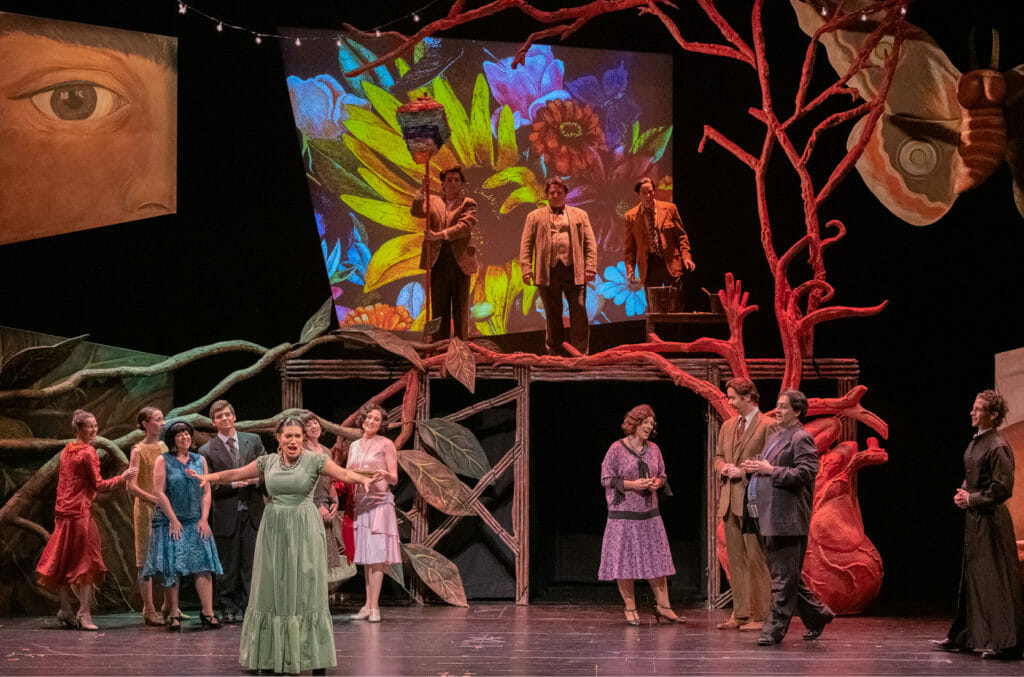
Colombian born soprano Catalina Cuervo in the title role of Frida skillfully captures every nuance of Kahlo’s fiery attitude and in equal measure exposes the pain and suffering the artist endured. Cuervo brings Cruz’s lyrics to life both with her considerable acting prowess and her rich Soprano tones, her natural, ringing vibrato resonating beautifully and bringing with it a sultriness that comes from a woman all too aware of her own power.
Opposite Kahlo in the role of her husband, famous Mexican painter Diego Rivera, is Texas-born baritone Ricardo Herrera in his FGO debut. Herrera takes on the role with aplomb, showcasing passion and powerful vocals, just enough to match that of Cuervo’s Frida without dousing her light.
One of the most striking things about this production initially, is the remarkable set, designed by Monica Essen using examples of Kahlo’s own artworks that occasionally revolve throughout the show to highlight Kahlo’s state of mind at that point in the narrative, and giving the performance a surreal, almost dreamlike quality. This, along with the clever use of a large screen hanging above the stage propels the plot, demonstrating that a picture really does tell a thousand words.
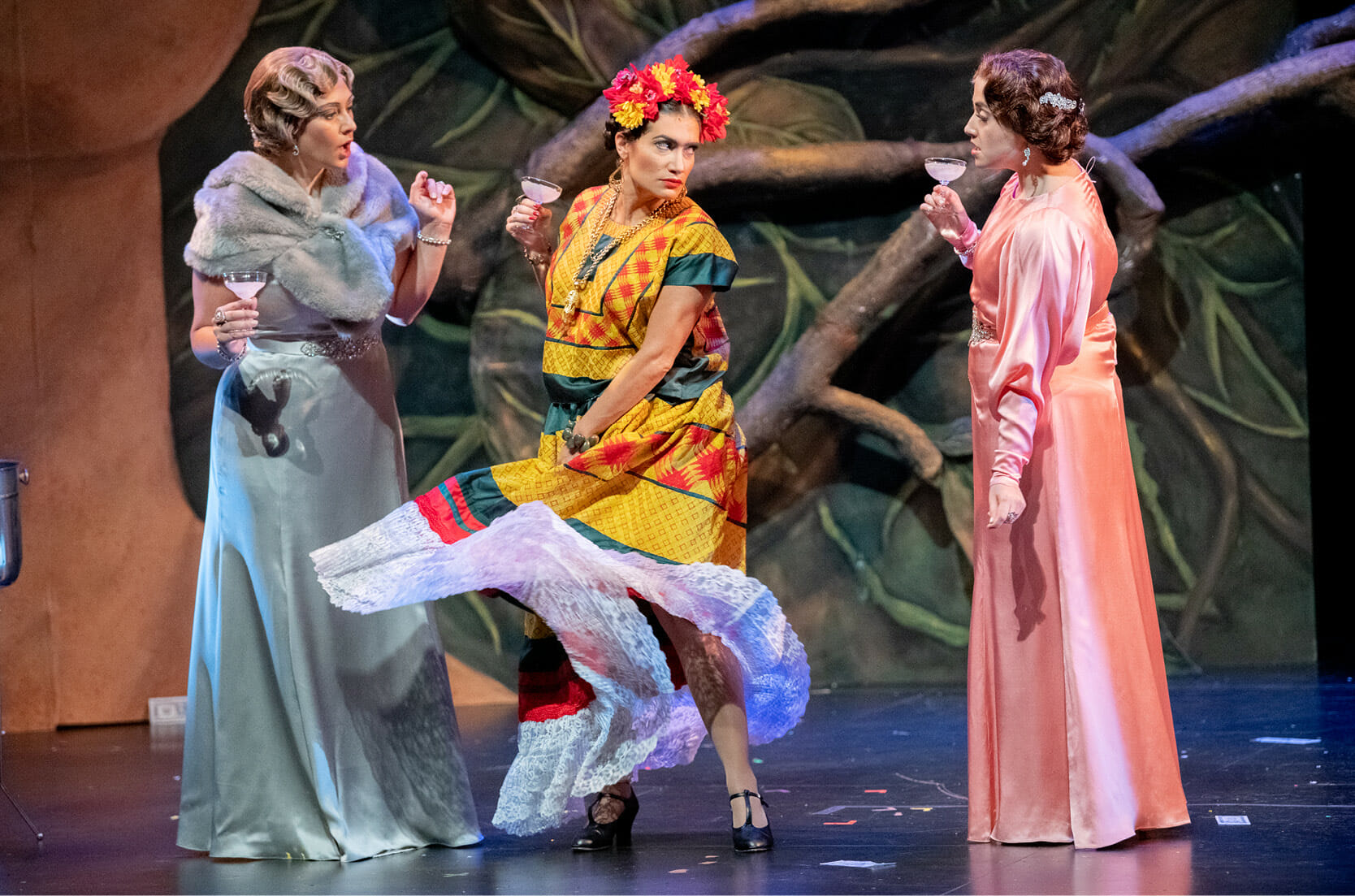
The costumes, also the work of Essen, are mostly traditional Mexican folk style, or other fashion of the period in which the opera takes place, and they serve to subtly juxtapose the bold symbolism of the set, whilst reminding us that despite its modern content, Kahlo’s world existed in a considerably different era to our own.
With direction by Marco Pelle, the production could not be in surer hands. Pelle is an experienced choreographer as well as director, and this influence is apparent from the outset as he masterfully combines ballet, interpretive movement, some rather grotesque puppetry, narrative monologues, and opera to paint a portrait (so to speak) of a tortured yet brilliant woman that is poignant, attentive to detail and at times erotic.
The overall effect of this combination of efforts is a powerful and thought provoking display of innovation and contemporary opera, not to mention a healthy amount of confetti. To use a quote from the opera itself, Frida is “bold beauty born of pain.”
For opera fans, admirers of Frida Kahlo and her work, or those simply looking for an engaging and enlightening evening of entertainment, look no further than FGO’s Frida.
Frida is playing at the Miami-Dade County Auditorium, March 21, 23 and 24, 2019. 2901 West Flagler Street, Miami, FL 33135 and at the Parker Playhouse March 28 and 30, 2019. 707 NE 8th Street, Fort Lauderdale, FL 33312.
For tickets call (800) 741-1010 or visit www.fgo.org
Erin Dahlgren has enjoyed playing many roles throughout her 15 year Musical Theater career, but is now appreciating her most challenging role yet, as mother to two young daughters. Erin is a Teaching Artist at the Broward Center for the Performing Arts and spends what little time she has left as a freelance writer.