An Interview with “Last Call Chicago” Authors Rick Karlin and St Sukie de la Croix
By Gregg Shapiro
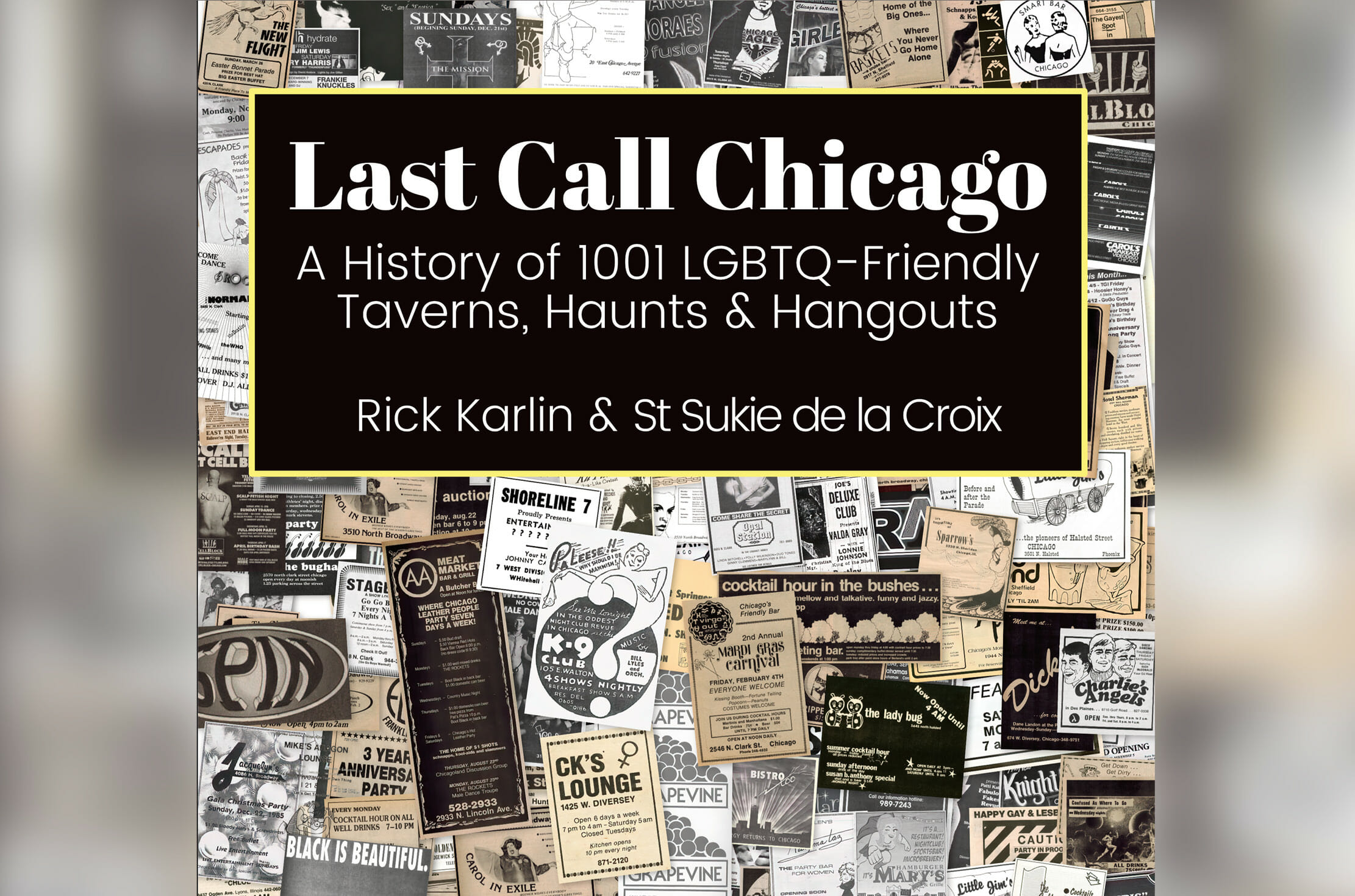
When it comes to bars as gathering places, many folks in the LGBTQ+ community understand how good it feels to be somewhere “where everybody knows your name,” to quote the theme song to the sitcom “Cheers.” It’s a sentiment shared by gay writers Rick Karlin and St Sukie de la Croix, authors of “Last Call Chicago: A History Of 1001 LGBTQ-Friendly Taverns, Haunts & Hangouts” (Rattling Good Yarns Press, 2022). Both writers agreed that by combining their history in, and knowledge of, the Windy City’s drinking establishments, they could come up with an indispensable guide, part encyclopedic reference book, part coffee-table book, and all fun. From 1920s speakeasies to present-day venues, “Last Call Chicago” invites readers to drink it in, soak up the memories, and even learn a thing or two in the process about the city they call (or once called) home. Rick and Sukie were generous enough to answer a few questions about the book in advance of its publication. [Full disclosure: Rick Karlin is Gregg Shapiro’s husband.]
Gregg Shapiro: I’d like to begin by asking you both to say something about the genesis of the project that became the book “Last Call Chicago.”
St Sukie de la Croix: An encyclopedia of Chicago gay bars was on my “wouldn’t it be nice to do” list of possible projects. However, I knew it would be a massive undertaking for one person and I wouldn’t have the time or energy. I forgot about it. Then Rick Karlin phoned me up with the idea. He’s very persuasive.
Rick Karlin: I was with a group of Chicago friends and one of them mentioned a bar from the late 1980s, all he could remember was that it was on the Chicago River and that you could get a boat ride there. I wrote for Gay Chicago Magazine from the late 1970s and became the entertainment editor in the mid-1980s and that meant I went to all sorts of bar events. I also wrote the magazine’s gossip column. I not only came up with the name of the bar he was thinking of, but I also gave them all the dirt on who owned it and why it closed and the names of other bars that later opened at that same location. Somebody said, “You should write a book about Chicago’s bars.” I didn’t think much about it, but then I read an article about how gay and lesbian bars were struggling because young people don’t feel the need to go to exclusively gay or lesbian clubs anymore. That was right about the time several of Chicago’s gay bars, Hunter’s. Nutbush and Little Jim’s were closed or torn down and I thought, this is our history. Someone should document it.
GS: How long did it take to create the book, from inception to completion?
RK: About four years. Originally it was going to be like the old bar guides, just the name, address, and a list of what type of clientele/focus it had (leather, preppy, disco, cruisy), the years it was open. Our publisher, Ian at Rattling Good Yarns Press, was the one who suggested we expand the focus.
GS: What makes you, individually and collectively, the right people to write this book?
RK: We were there, and we lived to talk about it! Sukie and I were both reporting for the LGBT press in Chicago, sometimes for the same publications, sometimes for rival ones. But we both were attending and hosting events, taking photos, and writing up on the diverse kinds of LGBT bars, from the posh and elegant bistros to filthy toilets. Plus, Sukie’s historical perspective and his archives, which I used when writing my memoir, “Paper Cuts,” was invaluable.
SSdlC: I’ve studied the history of LGBTQ Chicago for years. I wrote two books on the subject— “Chicago Whispers” and “Chicago After Stonewall.” However, Rick had been going to the bars and writing about them in newspapers from the 1970s into the 2000s. We’re both reporters and activists and we agreed on how important gay bars were to our history. Tenacity and stubbornness also helped.
GS: “Last Call Chicago” is a collaborative effort. How did that process work?
RK: It was a learning process for me. I’ve been an editor for a while, so that means, I’m used to being in the driver’s seat so to speak. I decide the direction and the pace. It’s more of a managerial position. With Sukie, it was more of a partnership, and we had to negotiate that. Also, we have very different ways of creating. I deliberately build things up in a very linear fashion. Sukie throws everything against the wall and then slowly peels away things layer by layer until he has what he wants. I liken it to the difference between pottery and sculpture.
SSdlC: We’re on opposite sides of the country—I’m in California and Rick’s in Florida. It was really like two people doing a long-distance jigsaw puzzle. We both set about collecting information and images. I had a list of 800 gay bars which is where we started out. We kept adding images and information we gathered from newspapers, friends, Gerber Hart (Library and Archives), Facebook, anywhere we could get it. It grew and grew. Rick and I have different ways of working, so there were disagreements sometimes, but in the end, we’re still friends and the book was published.
GS: What do each of you hope for readers to get out of “Last Call Chicago?”
RK: I hope it brings back memories and opens some floodgates. For me, it was a more carefree and innocent time. I came out before AIDS when sex and being gay was like being a kid with a new toy and going through this book brings back that feeling for me. Looking at the information on Broadway Limited, Bistro and The Bushes brings back one era in my life. Hanging out at the Closet, Ladybug and Paris with my gal pals brings back another. Singing along at piano bars or at Sidetrack evokes yet another flood of memories.
SSdlC: I hope it brings back memories for Chicagoans and those who visited the city over the years. It’s a bit like genealogy and Ancestry.com—researching where your family came from, your roots. “Last Call Chicago” shows the roots of the gay community in Chicago. It also brings to life long-forgotten heroes like Chicago Molly and Wilbur “Hi-Fi” White. Important then but lost in the mists of time.
GS: Please say something about the role of bars when it comes to the LGBTQ+ community.
SSdlC: Quite simply, bars are where we met when there was nowhere else to meet. Thankfully, in Chicago, the Mafia owned most of the bars and the corrupt police force took kickbacks. Their homophobia kept the bars open. And we must never forget that gay bars, the mob, and the cops were where our liberation began at the Stonewall Inn in New York.
RK: For those over a certain age, the bars were the only places we could truly be ourselves. They were our community centers, our refuge from having to live in the closet. Even if you were out to your friends and families, you often couldn’t be out at work, or when traveling alone. They were where we met the members of our families of choice. I think bars are still like that for the LGBT community, we just have more freedom to be ourselves everywhere (at least for now). There’s also something about being among your own kind that is comforting. You may be safe as a minority where you live, but it’s not like being part of the majority for the first time.
GS: What do you think are some of the things about Chicago bars that distinguish them from bars in other cities?
SSdlC: Drag. Illinois was the first state in the U.S. to legalize homosexuality (in 1961). The result was that “obvious” homosexuals—by that I mean, more feminine—moved to Chicago from all over the Midwest. There were drag bars everywhere.
RK: There doesn’t seem to be the same us vs. them mentality. I’m not naive, I know how segregated Chicago is, but you don’t have that kind of attitude at clubs where you can only get in if you have the right “look.” That’s why you seldom saw doormen and lines at clubs in Chicago. Of course, I’m talking about when I went to clubs and bars. it may be different now. Maybe it was then, and I just didn’t see it, but to me, it felt more egalitarian.
GS: There has been a lot of discussion of late, including a “New York Times” article, about the disappearance of lesbian bars. What do you think “Last Call Chicago” tells readers about the city’s history of women’s bars?
RK: Even when other cities had a dearth of women’s bars, Chicago was going strong. At one time there were about a dozen; Swan Club, Lady Bug, CK & Augie’s, Paris, Suzy B’s, Girlbar, The Patch, Razmataz, and, of course, the grandmama of them all, Lost & Found. Chicago’s always been a bar town, so the fact that women’s bars did better here is no surprise. But women always made less than men, which meant less discretionary income, and many lesbians were late bloomers, meaning they had children, which meant fewer free nights. So, it was always a tough go for women’s bars.
SSdlC: “Last Call Chicago” shows the readers that lesbian bars don’t last very long. Why? No idea. The thing I find interesting about that is that there were more lesbian bars back in the 1950s and before. I do know that with the emergence of Women’s Lib in the late-1960s, women got sick of spending their money in mafia-owned lesbian bars and started opening coffee bars instead. The earliest “bars” in the book were lesbian-owned cafes during prohibition.
GS: Gayborhoods are also under threat and have begun disappearing in many US cities. Please say something about the symbiotic relationship that Chicago’s gay bars have with the city’s evolving gayborhoods.
RK: The gay community is the pulse of a city. Gay men tend to be more willing to move into neighborhoods on the decline and fix up their homes and old apartments, whether they owned them or not. As they did so they looked for bars and restaurants and shops near their homes. To attract them those bars and shops (sometimes run by gays and lesbians) start to improve as they get more business, so the neighborhood becomes desirable to the mainstream market, who start to move in. Prices rose and the gay folks were priced out and moved to a new neighborhood and the process began again. At least that’s how it was until the 1980s when the gays and lesbians decided to buy the properties they were fixing up or opening bars in. Then we had neighborhoods that were gentrified, but the gay businesses didn’t have to move, since they owned the properties. However, many of the original gay settlers were renters and got priced out of the market, or if they owned the properties, sold them at a profit and moved to new up-and-coming neighborhoods. Now you have cities where the gay bars and clubs are in one neighborhood, while the folks that live in the neighborhood tend not to be LGBT. Or you have pockets of LGBT communities within mainstream communities. It’s what those of us of a certain age marched and protested for, mainstream acceptance, but I miss the “specialness” of being gay.
SSdlC: I haven’t lived in Chicago for eight years, so the city’s “evolving gayborhoods” is something I know nothing about. Haven’t we gone beyond the ghetto mentality? A part of my reason to participate in this project was to document something that was disappearing. I too mourn the loss of our newspapers, bars, etc. but life moves on. Having said that, it’s still important for gay folks to have a safe place to go, but maybe bars don’t need to be in one gayborhood anymore.
GS: Please name a couple of things you were surprised to learn while doing research for the book.
RK: How one location would be home to one gay bar after another and, how many downtown hotel bars in the ’50s were gayer than any place on Halsted.
SSdlC: I was surprised that we found 1001 establishments.
GS: “Last Call Chicago” has the potential to be an invaluable research tool. What would it mean to you if it was used in that way?
RK: I would be so honored. I am a journalist and editor, not a historian.
SSdlC: When we started out, I saw this as a coffee table book. I’ve changed my opinion since then. What changed it was how much general gay history is documented in the book. It’s about bars and bar life, but also all the fundraisers that took place—Anita Bryant, AIDS. And for LGBTQ groups like Horizons, Dignity, TPAN … the bars are a part of their history too.
GS: “Last Call Chicago” is full of fun graphics: images and adverts for the various and sundry bars. Are there one or two that stand out to each of you as favorites?
SSdlC: My favorite is for the K9 club. Only because it was a stroke of luck how I found it. I had heard rumors about the K9 drag bar, that it was a speakeasy during prohibition. When prohibition ended the K9 club opened for a brief period before it was raided and shut down. I scoured the papers and found the ad in a 1933 “Chicago American.”
RK: I concur. The K9 Club at 105 E. Walton from the 1920s and ’30s, opened during the “pansy craze” with its cartoon of a fop screaming, “Pah-leese!! Why should I be mannish?” Also, the ads from the ’70s with drawings of ultra-butch men with huge baskets!
GS: Is there a bar that closed before you had a chance to visit it that you wish you could have been to for a drink and a dance?
RK: I never went to Kitty Sheon’s on Rush or Le Pub to see Karen Mason perform. Karen and I became friends later, but I would have loved to see her before a gay crowd back then. I’d also like to have been to the Blue Dahlia – I later found out that my parents went there often.
SSdlC: If I could build a time machine, I’d go back to the Green Mask, a lesbian joint in the 1920s. You’ll have to read the description in the book to see what I mean.
GS: If you could open a new bar in Chicago, what would you call it and what would distinguish it from the others in the area?
SSdlC: I’d call it the White Swallow and there would be live rock bands, no alcohol, just marijuana and chocolate eclairs. And no karaoke. And no disco. Saturday nights would be senior’s night, when we can all sit around getting stoned while discussing Doris Day and our upcoming colonoscopies. Sounds like heaven to me.
RK: I might open something in the old Legacy 21 space, just so I could get my hands on the Hirschfeld mural they had on one wall. It’s very rare. I wanted to print a picture of it in our book, but the royalties were outrageous. Other than that, I wish they’d open a Sidetrack in Wilton Manors, Florida, where I live now (hint, hint Arthur and Pepe).
GS: Is there a future book in the works on which you’d both collaborate?
SSdlC: I wouldn’t rule it out.
RK: What she said.